
Is Amazon Winning the Cloud Race?

Posted on by Randy Bias

From our perspective, it looks like Amazon is winning the cloud race.   Amazon and Google pioneered the notion of ‘devops‘, where agile practices are applied to merging the disciplines of development and operations.  Devops teams are inherent to cloud computing.  They are the only way to scale and compete.

For example, in my conversations with Amazon it’s been explained how their operations team is really only two parts:

  1. Infrastructure Engineering: software development for automating hardware/software and building horizontal service layers
  2. Datacenter Operations: rack & stack and replace broken hardware

There isn’t a team that manually configures software or hardware as in traditional operations teams or enterprise IT. This is by design.  It’s the only way to effectively scale up to running thousands of servers per operator.

More importantly, by automating everything, you  become fast and agile, able to build an ecosystem of cloud services more rapidly than your competitors.

With the possible exception of Rackspace Cloud, I’m not sure that anyone else is  in Amazon or Google’s league.  Amazon in particular, has a track record that is incredibly impressive.

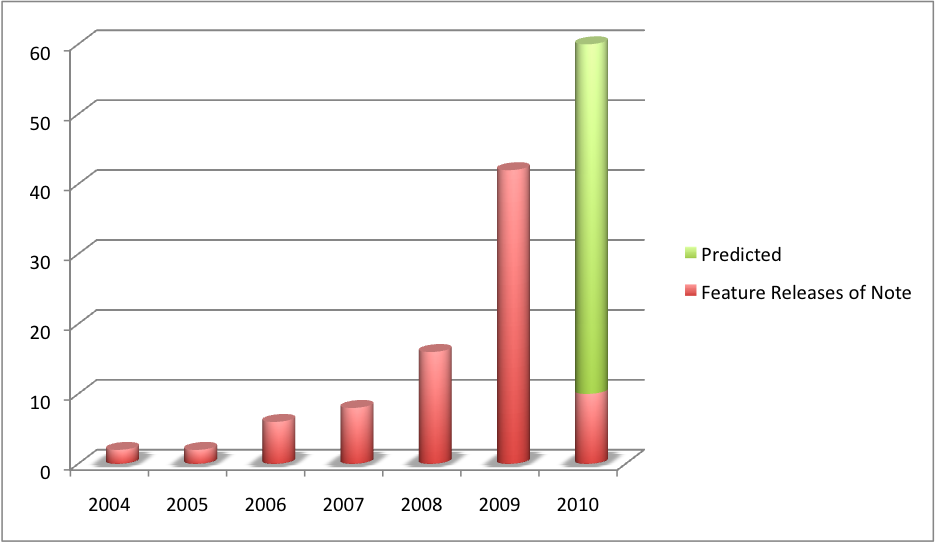
From a  quick culling of all of the Amazon Web Services press releases since the launch of it’s initial service (SQS in 2004), after removing non-feature press releases and minor releases of little value, we  came up with the following graph:
aws-feature-releases-by-year

The trend is clear.  Since Amazon’s start, they have accelerated rapidly, almost doubling their feature releases every year.  2009 was spectacular with 43 feature releases of note.  Since the beginning of 2010, Amazon already has 8 releases of note.

In contrast, traditional hosting companies moving into cloud computing are hobbled by running two teams: development and operations.  Expect the gap to widen as more hosting companies continue to misunderstand that this race isn’t about technology; it’s about people, software, and discipline.

So what’s the takeaway?  Simply put, in order to be a major cloud player you need to change how you do IT and build clouds.  Either hire someone who can bring the devops practice into your shop or engage an cloud computing engineering services firm like Cloudscaling  to help you build fast, nimble teams that focus on automation and rapid release cycles.

This entry was posted in Cloud Computing. Bookmark the permalink.

Previous post:
Next post:

  • Ray Nugent

    Amazon is redefining IT operations. It will eventually result in the elimination of OPs as it exist today all together. The traditional sys admin will become a specialized software developer just like any other software discipline. I think the Devops term will go the way of Webmaster indicating the early nature of this industry. You're right, Cloud is less about technology and more about people – for now.

  • Pingback: uberVU - social comments

  • Pingback: Tweets that mention Is Amazon Winning the Cloud Race? | Cloudscaling -- Topsy.com

  • Pingback: Cloud innovators and cloud pretenders | Kavis Technology Consulting

  • http://twitter.com/cloudbzz JohnTreadwayCloudBzz

    Randy – not sure if your press release prediction will hold true. It's end of Q1 and they are at less than 1/4 of last year's total. That said, they are certainly winning the innovation race and everybody is playing catch up. Google and Microsoft have gone in different directions, so the comparison does not work. But for IaaS clouds it's hard to see anybody catching them on a pure features basis for general purpose workloads.

    • http://cloudscaling.com randybias

      The primary point is that they have a tremendous pace and I don't see anyone else gearing up to play that game except maybe Rackspace Cloud. It's just not enough to 'play catchup'. AWS' EC2 went from zero to 40K machines in 3 years. At 100% growth they will be larger than every other hoster out there by end of 2010. It takes a couple of years to build a team that can execute like this. If other hosters and service providers don't build similar kinds of teams soon they will be at a serious disadvantage.

      • http://twitter.com/cloudbzz JohnTreadwayCloudBzz

        You're right that they seem to be on a plane of their own at this point. However, in the scheme of things, especially where the real money is spent (enterpri$e), their cloud revenue is a rounding error. If and when the enterprise market truly arrives (it's just playtime now), Amazon's advantages may not be enough. When personal selling and relationships matter, the best and most innovative products don't always win. Beating Rackspace and a bunch of smaller cloud providers or slower telcos is one thing. Beating Microsoft, IBM, HP/EDS, and other giants when the applications matter is quite another.

        Whether Amazon maintains its dominance or not in the long run,they have the whole market marching to their drum and have changed the face of computing at a fundamental level.

        • http://cloudscaling.com randybias

          I agree. And the first true enterprise cloud platform that executes like AWS could have a tremendous advantage.

  • http://stage.vambenepe.com/ William

    Agree with CloudBzz that “hard to see anybody catching them on a pure features basis for general purpose workloads” (at least in the short to medium term) but I am not the IaaS battle is going to be won on “features”.

    • http://cloudscaling.com randybias

      I disagree. 'Features' here includes the EU rollout for S3/EC2 and the CloudFront rollout in Singapore/Asia. It also includes capabilities that clearly expand the offering out of the 'consumer' realm, like VPC. While it certainly doesn't mean that all enterprise use cases are handled, it continues to lower the barriers and provide access to a larger part of the market.

      Features in and of themselves perhaps won't 'win' the battle, but what they represent certainly can. As AWS continues to allow more different types of businesses & use case to onboard, expands their footprint globally, and fixes 'problems', they create an even larger feature gap between themselves and their competitors.

      Another way to say this is: “don't bring a knife to a gun fight.” Most hosting and service providers are bringing knives. But that's not going to result in much besides blood on the floor.

  • http://twitter.com/germanretana German Retana

    Could it be possible that at the pace Amazon is including features, it may end up with a product that is more complex and sophisticated than needed? What if IaaS as Amazon is building it ends up with features beyond what the majority of the users need?

    Think in terms of a disruptive innovation. Amazon's rapid growth (in any dimension, servers, consumers, features) might open the door for “cheaper, simpler, smaller, and … more convenient to use” (Clayton Christensen, 1997) solutions from other vendors. For a cloud newbie, perhaps the ability to talk to someone or have someone from the provider's to team help you out deploy might become more valuable.

    Now, this help does not necessarily come from the IaaS vendor, but can come from the bunch of brokers already out there. Is this money Amazon is leaving on the table?

    • http://cloudscaling.com randybias

      It's possible, but seems unlikely. Amazon is actually the disrupter in this case and is much simpler, cheaper, and easier to use than the old way of doing IT (e.g. buy hardware, rack & stack, hire operators, negotiate bandwidth, etc. etc.).

      Hard to see how the current disrupter would be disrupted so quickly. More likely, your scenario would come to fruition in another 5-10 years once cloud computing is the established incumbent.

      Right now cloud computing is the up and comer.

  • Jordan Braun

    Yes Amazon is the godfather of public cloud computing and their growth is tremendous. I do agree with others that the IaaS space is largely growing and gaining ground by adding feature sets that more enterprise organizations require. Better security, greater performance, stronger SLAs, and lets not for get the power of VMware and how widely those tools are being used with in the enterprise.

  • Pingback: Amazon Web Services’ Rapid Release Cycle | Cloudscaling