
Cloud Futures Pt. 1: Service Clouds
With cloud computing rapidly accelerating it can be hard to see the road ahead. I hope to help with this in my own way through this short four part series where I’ll outline how I think this is all going to play out. It’s clear that the marketplace will continue to become increasingly competitive and that at some point blood will be shed. This is your survival guide to weathering the coming storm.
Service Clouds I’m borrowing this notion from Alistair Croll (linkedin, twitter, blog), because it’s smart, can be bent to my needs, and makes the most sense in the end game. By end game, I mean that eventually, most clouds will probably be service clouds. Why? Because service clouds offer the best opportunity to expand your market. Let me explain.
Service clouds shy away from the notion that you must be either Infrastructure-as-a-Service (IaaS), Platform-as-a-Service (PaaS), or Software-as-a-Service (SaaS). They provide a slice of on-demand services that include all of these as shown in this diagram:
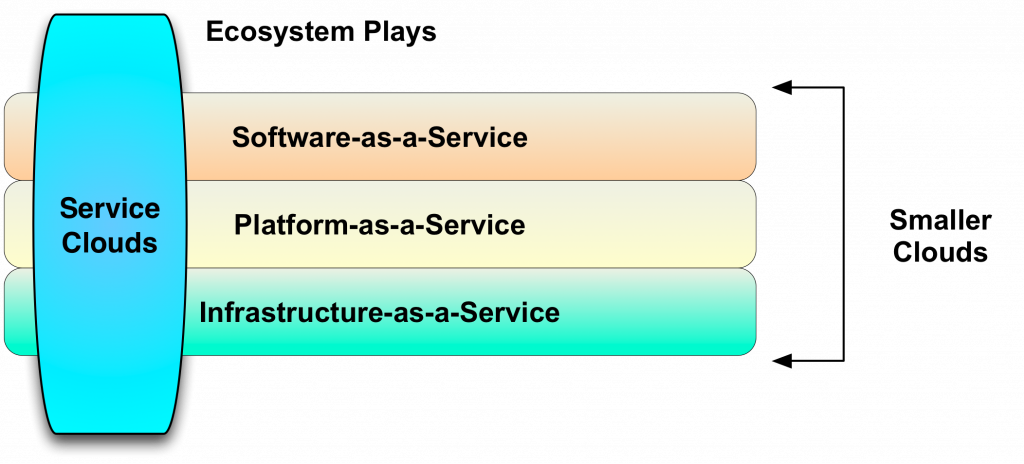
The best examples of service clouds are Amazon, Google, and Microsoft. All three either provide, or are in the process of providing, a complete ecosystem that includes elements of infrastructure, platform, and software (applications). Service clouds are also ‘cloud platforms’ (not to be confused with PaaS). Platform in the same sense that an operating system is a ‘platform’.
Service clouds are the future. All cloud computing providers will eventually converge towards this model … for the most part.
Market Evolution I can’t locate the original blog posting, but I once read that there are essentially three ways to be #1 in a given market:
-
first
-
best
-
cheapest
I think everyone understands this at least on an intuitive level, which means that most cloud players are going to try and stake out a territory as either first, best, or cheapest. If we assume for now that service clouds are the ‘best’ way to deliver cloud services, then surely it’s important to understand what ‘first’ and ‘cheapest’ might mean. I’ll take a stab and say these are probably ‘targeted clouds’ and ‘commodity clouds’ respectively.
Targeted clouds are usually smaller cloud players who realize that since the Amazon’s and Google’s of the world are already ‘first’ to the general market they better be first to a specific market segment.
Commodity clouds are larger businesses that may not be able to compete with Amazon or a Google on innovation, but command enough buying power to shrink wrap solutions using best-of-breed software and price everyone else out of the market. Think ‘utility computing’.
We’ll cover both targeted and commodity clouds in Pt. 2 & Pt. 3, and then wrap up some predictions in the final installment.